
Hospital-grade flooring, Florida-built
Seamless, non-porous, low-VOC coating systems for infection-controlled spaces. Installed in occupied facilities without evacuating wings. UF Hospital is on our client roster.
Not the same job as a warehouse
Healthcare environments aren't just another commercial floor with a cleaner logo on the wall. Infection control, occupant safety during installation, chemical disinfectant exposure, and continuous 24/7 operations create constraints that most coating contractors aren't equipped to handle.
Seamless, non-porous flooring is the baseline. Joints and grout lines collect bacteria and moisture — which is why the CDC's Guidelines for Environmental Infection Control in Health-Care Facilities and the FGI Guidelines for Design and Construction of Hospitals both favor monolithic resinous systems in infection-control spaces.
Compliance by design
CDC HICPAC Guidelines
Seamless, non-porous assemblies eliminate joints and grout where bacteria and moisture collect. Supports hospital environmental cleaning protocols.
Integral Cove Base
In high infection-control areas, FGI requires smooth, monolithic floor assemblies with integral wall base extending up the wall a minimum of 6 inches. We install cove base to spec.
Low-VOC Installation
Low-VOC epoxy systems meet LEED IEQc4.2 limits and can be installed in occupied facilities without evacuating wings or patients.
Slip Resistance
Static coefficient of friction at or above 0.5 for walkway surfaces. Aggregate finishes available for wet zones where additional slip resistance is required.
Talk to an owner about your specs
Built to survive daily disinfection
Healthcare floors see bleach, quaternary ammonium compounds, hydrogen peroxide, and specialty hospital disinfectants every single day. Standard epoxy yellows and micro-cracks under repeated bleach exposure. Healthcare-grade epoxy formulations are designed for those specific chemistries.
We spec systems based on the disinfectants your facility actually uses — so the floor outlasts the cleaning schedule.
Every medical slab gets tested
Vapor emission from concrete is the #1 cause of healthcare flooring failures. We run ASTM F1869 calcium chloride and ASTM F2170 in-situ relative humidity testing before spec. Thresholds:
Exceeds those numbers? We install a moisture mitigation membrane before the coating. Skipping this step is why hospital floors fail 18 months after install.
Hospitals don't close for flooring
Self-leveling epoxy systems (roughly 1/8" / Type 4) handle corridors, procedure rooms, and operating theaters with light traffic return in 24 hours and full-service return in 48-72 hours.
When sequencing demands faster return-to-service, we deploy fast-cure systems that let you restore operations within hours.
Hospital pharmaceutical clean room
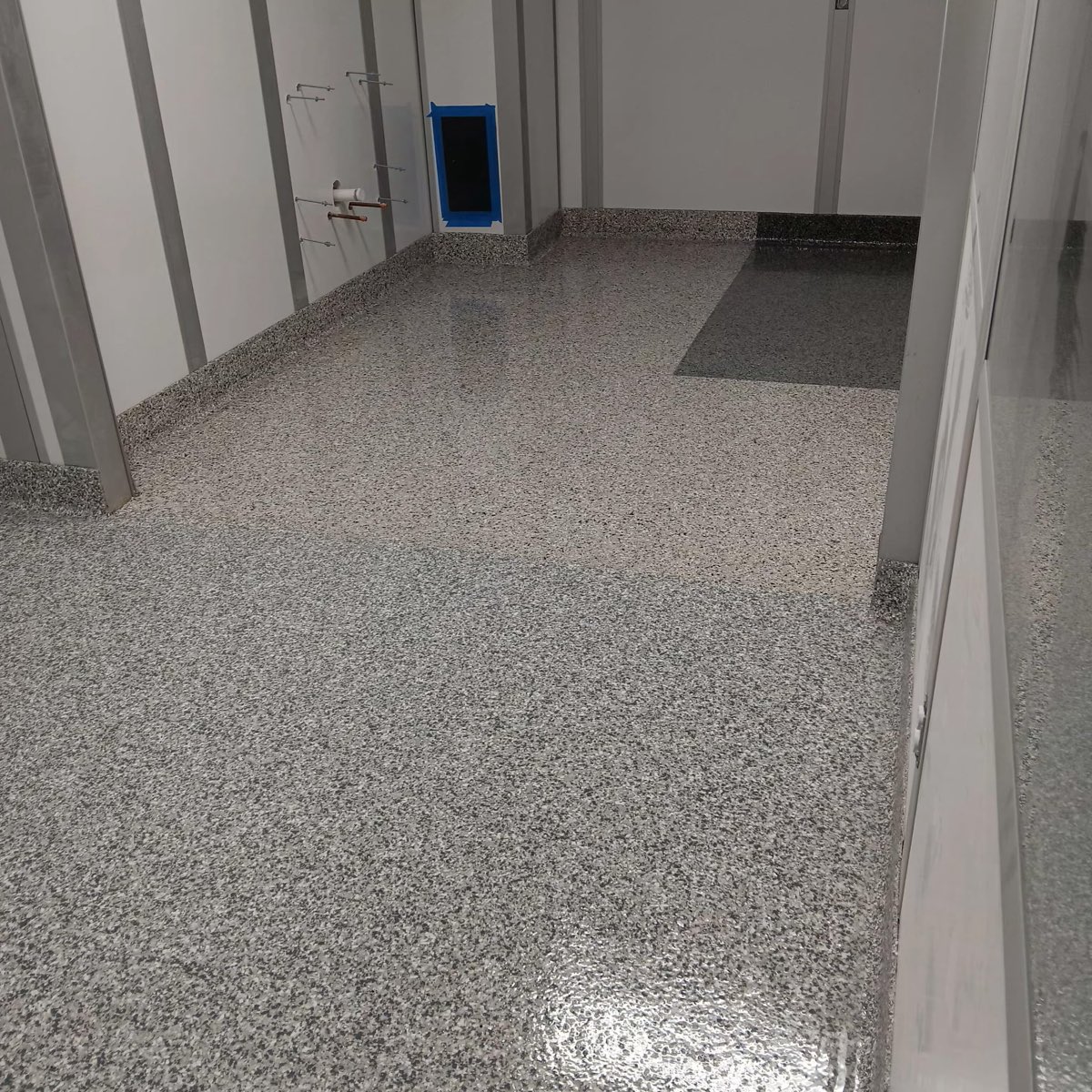
1,200 sq ft of seamless Elastaflake RFS installed across hospital clean rooms. Multiple flake colors and defined boundary lines establish clean and dirty zones, with integral cove base and a non-porous, chemical-resistant surface built to be decontaminated wall to wall.
View Case Study arrow_forwardInstitutions trust Phoenix
UF Health
Moisture-critical flooring in occupied hospital spaces.
University of Florida
Campus facilities including research and teaching spaces.
County & Federal
Volusia County, Hillsborough County, Avon Park AFB.
Need a facility floor done right?
Moisture testing · CDC/FGI-aligned specs · Low-VOC occupied install · Fast-cure sequencing.
Standards & guideline references expand_more
- CDC Guidelines for Environmental Infection Control in Health-Care Facilities (HICPAC).
- FGI Guidelines for Design and Construction of Hospitals — integral cove base, monolithic floor assemblies in infection-control areas.
- ASTM D2047 — static coefficient of friction test for polish-coated walkway surfaces.
- ASTM F1869 — calcium chloride moisture vapor emission rate test for concrete slabs.
- ASTM F2170 — in-situ relative humidity test using embedded probes.
- LEED IEQc4.2 — low-emitting materials, VOC limits for floor systems.